Legal Guardianship for Persons with Disabilities

Legal Guardianship for Persons with Disabilities – Eligibility, Process, Documents & Rights
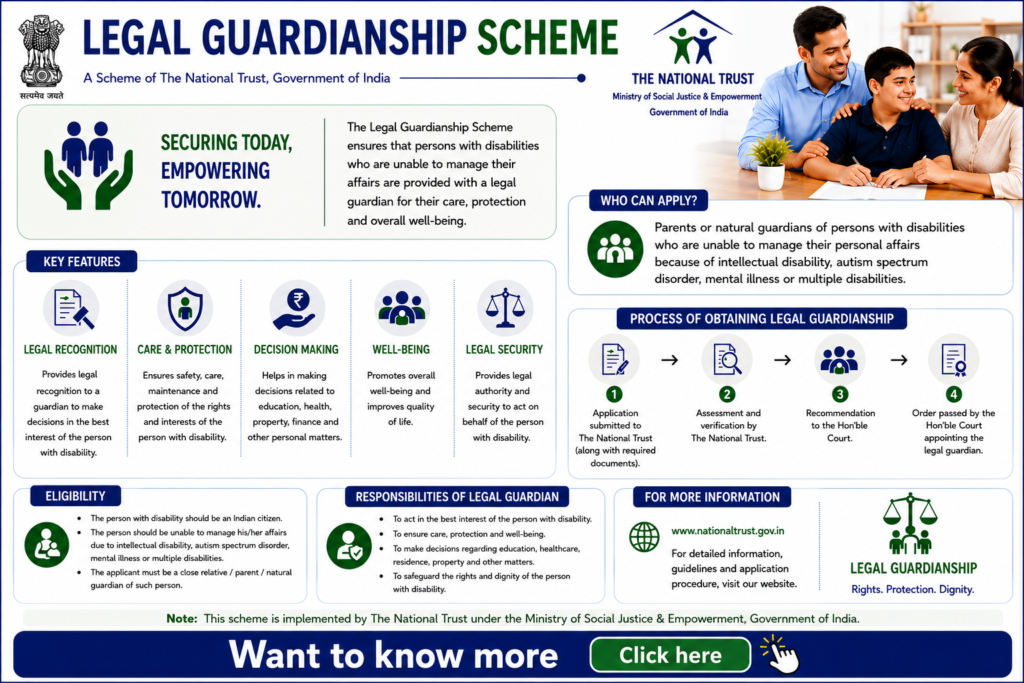
Legal Guardianship is a legal mechanism through which an eligible person is appointed to support and protect the interests of a Person with Disability who may require assistance in managing personal matters, legal matters or property.
For Persons with Autism, Cerebral Palsy, Intellectual Disability and Multiple Disabilities, the National Trust provides a specific legal guardianship mechanism through the Local Level Committee (LLC). The purpose is not simply to appoint someone to “take decisions”, but to ensure that the person’s care, protection, rights, welfare and property interests are safeguarded.
Why is Legal Guardianship Important?
Parents often have one major concern:
“What will happen to my child when I am no longer able to take care of them?”
Legal guardianship can become an important part of long-term planning for a person with disability.
A properly appointed guardian may support the person’s interests in areas such as:
- Food, clothing and shelter
- Health and medical care
- Education and training
- Employment and vocational needs
- Personal care and maintenance
- Protection from exploitation and abuse
- Protection of legal and human rights
- Management and protection of property/assets
The National Trust regulations specifically identify these areas while considering guardianship.
Who Can Come Under National Trust Legal Guardianship?
The National Trust’s legal guardianship mechanism applies to persons with:
AutismCerebral PalsyIntellectual DisabilityMultiple Disabilities
The need for guardianship is assessed individually. Having a disability does not by itself mean that a person automatically requires a guardian. The Local Level Committee assesses whether guardianship is genuinely required and the nature of support needed.
This is particularly important because some persons may be able to make many decisions independently with appropriate support, while others may require greater assistance.
Who Can Apply for Guardianship?
Under the National Trust regulations, the following may apply, depending on the circumstances:
For a destitute or abandoned person who needs guardianship, the LLC may direct a Registered Organisation to initiate the process.
👨👩👧 Parents
Both parents may jointly apply. In specified circumstances where one parent is absent, the other may apply singly.
👨👩👧👦 Siblings
Where parents are unavailable due to circumstances such as death, desertion or conviction, siblings may apply.
👪 Relatives
A relative may apply when parents and siblings do not apply or are unavailable.
🏢 Registered Organisation
In certain situations, a Registered Organisation may apply.
Who Can Be Appointed as Guardian?
The applicant may indicate an appropriate person for consideration as guardian.
This may include:
- Parents
- Siblings
- Family members
- Another suitable person
- Eligible registered institution/organisation
The LLC considers the suitability and capability of the proposed guardian. The person proposed as guardian must satisfy the applicable requirements under the National Trust regulations.
For example, the regulations specify requirements relating to citizenship, mental capacity, criminal history and financial circumstances.
Local Level Committee (LLC)
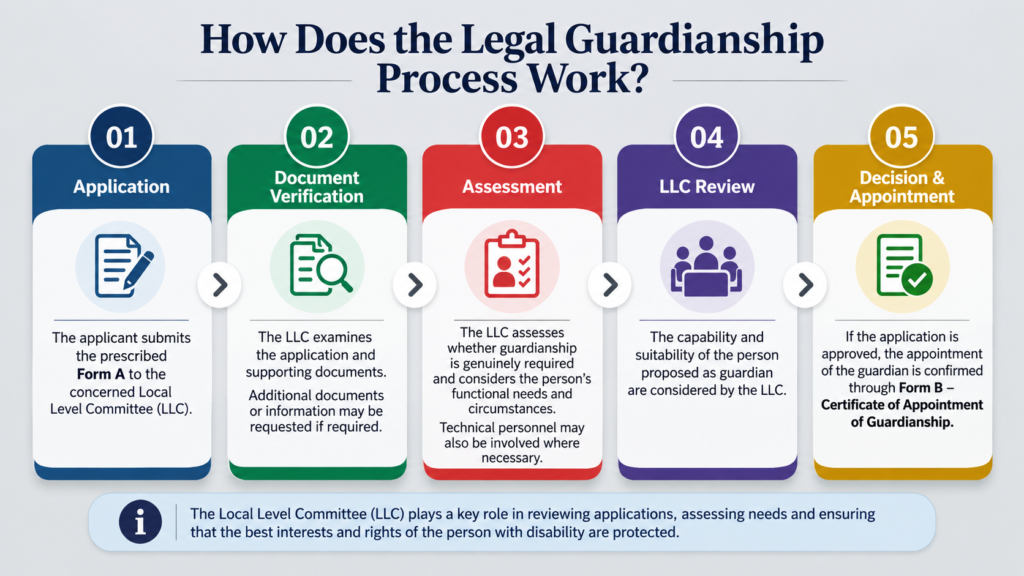
The Local Level Committee (LLC) plays a central role in the National Trust legal guardianship process.
The National Trust states that the LLC is headed by the District Collector and is empowered to receive guardianship applications and appoint guardians under the National Trust framework.
The LLC may:
- Receive the guardianship application
- Examine the submitted documents
- Ask for additional information
- Assess the person’s need for guardianship
- Assess the suitability of the proposed guardian
- Conduct/arrange assessment and home visit as applicable
- Consider the person’s care, welfare and property interests
- Confirm appointment of the guardian
The territorial jurisdiction of an LLC is defined for a specified area/district, and the applicant and ward generally need to fall within that jurisdiction.
Documents Generally Required
The exact documents may vary because the LLC can ask for additional supporting documents. The National Trust’s guiding list includes:
- Birth Certificate / Age Proof
- Residence / Address Proof
- Disability Certificate
- Applicant’s identity documents
- Guardian’s relevant documents
- Consent documents, where applicable
- Documents relating to movable/immovable property, where applicable
- Reason for a single-parent application, where applicable
- Other documents requested by the LLC
The National Trust states that self-attested photocopies may be submitted and originals may be requested for verification when necessary.
Important: Parents should confirm the current document checklist with their concerned LLC before submitting the application.
What Are the Responsibilities of a Guardian?
This is one of the most important sections for parents. Being a guardian is not merely a formal designation. A guardian has responsibilities towards the care, protection, welfare and interests of the person with disability.
The guardian may be responsible for matters relating to:
❤️ Personal Care
Ensuring appropriate food, clothing, shelter and day-to-day support.
🏥 Healthcare
Supporting access to necessary medical care and treatment.
🎓 Education & Training
Supporting education, vocational training and skill development according to the person’s needs.
💼 Employment & Development
Supporting appropriate employment or vocational opportunities where applicable.
🛡️ Protection
Protecting the person from exploitation, abuse, neglect and situations that may harm their interests.
💰 Property & Assets
Where applicable, responsibly managing the person’s movable and immovable property and maintaining the required records.
Guardian’s Responsibility Towards Property
Parents should pay special attention to this part.
Where the guardian has responsibility for the property/assets of the person with disability, the National Trust framework requires reporting and accounting.
Within 6 Months
The guardian is required to submit an inventory of immovable property and assets/movable property received on behalf of the person with disability, along with relevant claims, debts and liabilities.
Every Financial Year
The guardian must furnish an account of the property and assets, including amounts received, amounts spent on behalf of the person with disability and the remaining balance, within the prescribed period after the financial year closes.
The National Trust’s LLC page identifies these as Form C and Form D requirements.
Can a Guardian Be Removed?
Yes.
Legal guardianship is accompanied by safeguards.
If a guardian is found to be:
- Abusing the person with disability
- Neglecting the person
- Misusing or misappropriating their property
- Failing to provide required care
- Otherwise acting against the person’s interests
a parent, relative or Registered Organisation may approach the LLC for removal according to the prescribed procedure.
The LLC can investigate the complaint and, where grounds are established, remove the guardian and make arrangements for a new guardian or appropriate care and protection.
Protection Against Abuse & Neglect
The National Trust’s guidelines specifically recognise serious forms of abuse and neglect, including:
- Physical abuse
- Sexual abuse
- Deprivation of basic needs
- Solitary confinement
- Chaining or similar restrictive treatment
- Misuse of the person’s property
- Failure to provide appropriate rehabilitation/training
- Inadequate care or support
These safeguards are important because guardianship is a responsibility and not ownership over the person or their property. The guardian is expected to act for the welfare and protection of the person with disability.
Legal Guardianship & Independence
One important point parents should understand is that guardianship should be approached according to the individual’s actual support needs.
A person with disability may be able to make some decisions independently while needing assistance in other areas.
The National Trust itself notes that in some cases, particularly where enabling mechanisms allow greater independence, limited guardianship may be appropriate.
Therefore, parents should focus on:
“What support does my child actually need?”
rather than assuming that every person with a disability needs the same level of guardianship.
What Happens After the Parents Are No Longer Able to Provide Care?
This is one of the biggest reasons families should think about future planning.
Parents can consider:
- Who could support their adult child?
- Who understands the person’s needs?
- Who can responsibly manage personal matters?
- Who can protect the person’s property and financial interests?
- Where will the person live?
- Who will coordinate healthcare and services?
- Who will ensure continuity of education, vocational activities or employment?
- What support will be available if the proposed guardian is no longer able to continue?
Legal guardianship can form one part of a broader long-term support plan for the person with disability.
Legal Guardianship is NOT About Taking Away Dignity
A very important message for parents:
Guardianship should not be viewed as taking away a person’s identity, dignity or individuality.
Its purpose is to provide a legal framework for care, protection and support where a person genuinely requires assistance.
The person’s abilities, preferences, dignity and best interests should remain central to decisions made on their behalf.
How Parents Can Prepare Before Applying
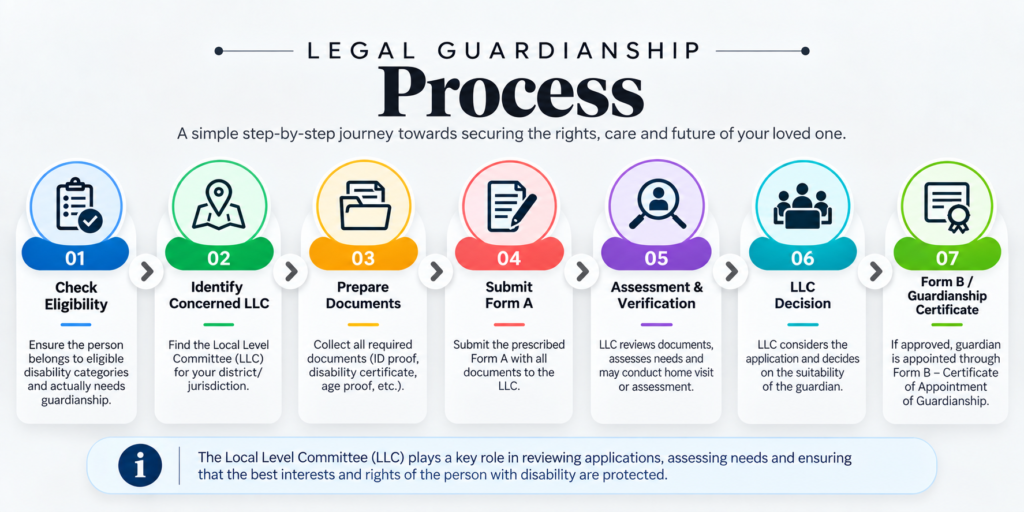
Before starting the process, parents can keep these things ready:
1. Disability Certificate / UDID
Keep current disability-related documents organised.
2. Identity & Address Documents
Keep the beneficiary and applicant’s documents ready.
3. Medical & Functional Information
Keep relevant reports and information about the person’s support needs.
4. Family Information
Clearly understand who is available to support the person in the future.
5. Property Information
If the person has movable or immovable property, maintain proper records.
6. Future Care Plan
Think about residence, healthcare, education/vocational activities and financial support.
7. Proposed Guardian
Choose someone responsible, trustworthy and capable of supporting the person’s interests.
Important: Guardianship Does Not Mean Property Ownership
This is something parents should clearly understand.
A guardian is appointed to protect and manage the interests of the person with disability, including property where applicable.
The person’s property does not become the personal property of the guardian.
The National Trust framework includes specific reporting and accounting requirements for property and assets under guardianship.
One Important Message for Parents ❤️
Legal guardianship is not only about paperwork. It is about planning for the future of your child.
Parents may spend years planning their child’s education, therapies, vocational training and healthcare. Future legal and care planning is equally important, especially when the person may need continued support after the parents are no longer able to provide it.
A thoughtful guardianship plan can help ensure continuity of care, protection, rights, property interests and decision-making support throughout the person’s life.
⚠️ Important Note
Legal Guardianship is a legal matter, and the exact procedure, documents and applicable requirements should be confirmed with the concerned Local Level Committee (LLC) before applying.
The National Trust’s official website currently provides online options for Apply for Guardianship, Track Application and Submit Form C & D.
The National Trust’s Documents section also lists a June 2026 clarification regarding appointment of legal guardians under the RPwD Act, 2016 and the existing National Trust Act, 1999. Because legal requirements can change, Help 4 Special should avoid presenting old rules as universally applicable and should encourage parents to verify the latest position with the concerned authority.