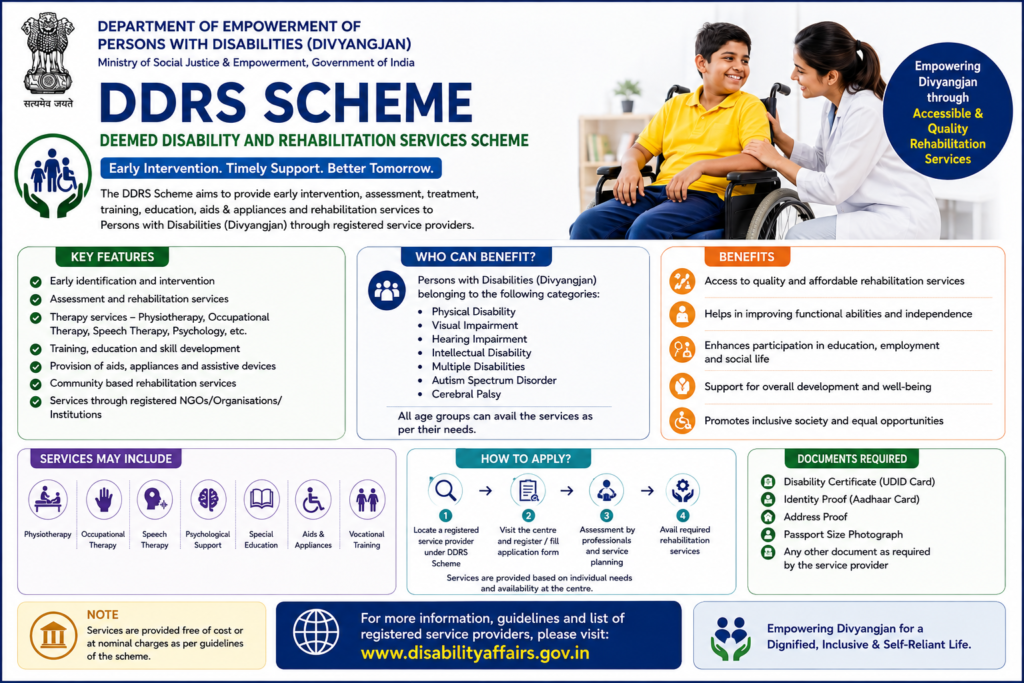
Deendayal Divyangjan Rehabilitation Scheme (DDRS)

Government Grant Support for NGOs working in Disability Rehabilitation
The Deendayal Divyangjan Rehabilitation Scheme (DDRS) is a Central Sector Scheme of the Department of Empowerment of Persons with Disabilities (DEPwD), Ministry of Social Justice & Empowerment, Government of India.
Under DDRS, the Government provides Grant-in-Aid (GIA) to eligible Non-Governmental Organisations (NGOs) for implementing approved projects related to the rehabilitation and empowerment of persons with disabilities.
The scheme aims to help persons with disabilities attain and maintain their optimal physical, sensory, intellectual, psychological and socio-functional abilities, while promoting equal opportunities, social justice and empowerment.
Objectives of DDRS
The major objectives of DDRS are to:
- Create an enabling environment for equal opportunities and social inclusion
- Promote equity, social justice and empowerment of persons with disabilities
- Encourage voluntary organisations to provide rehabilitation services
- Support effective implementation of the Rights of Persons with Disabilities Act, 2016
- Make rehabilitation and support services more accessible to persons with disabilities
Who Can Benefit from DDRS?
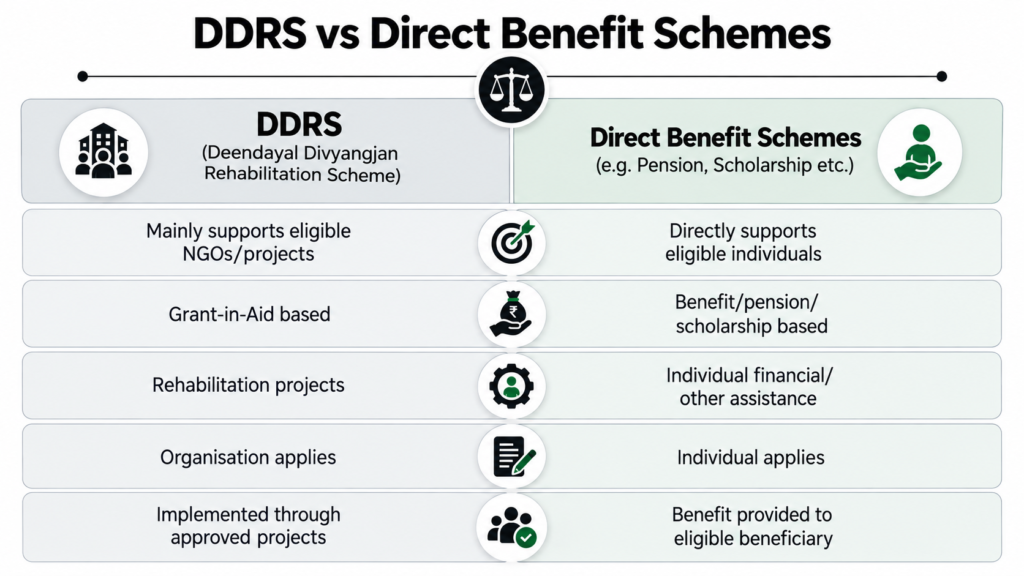
DDRS is primarily a grant-in-aid scheme for eligible organisations, rather than a direct individual cash-benefit scheme.
Eligible NGOs/organisations can seek Government assistance for approved rehabilitation projects, subject to the conditions and guidelines of DDRS. The organisation should have appropriate resources, facilities and experience to undertake the proposed programme and should meet the other eligibility conditions prescribed under the scheme.
Major Projects Supported Under DDRS
The scheme provides support through various model projects, including:
1. Early Intervention & Rehabilitation
Cross-disability pre-school and early intervention programmes, including home-based and community-based rehabilitation.
2. Special Education – Hearing Impairment
Special schools for children with hearing impairment, with options for home and community-based rehabilitation.
3. Special Education – Visual Impairment
Special schools for children with visual impairment, including deafblindness and low-vision services.
4. Special Education – Other Disabilities
Special schools and rehabilitation programmes for persons with Intellectual Disability, Cerebral Palsy, Autism Spectrum Disorder, Multiple Disabilities, Muscular Dystrophy, Deafblindness and other specified disabilities.
5. Rehabilitation of Cured Leprosy Persons
Rehabilitation programmes with home and community-based rehabilitation options.
6. Halfway Homes
Psychosocial rehabilitation services for treated and controlled persons with mental illness.
7. Learning Disability Support
Early intervention and therapy centres supporting children with specific learning disabilities and inclusive education.
8. Cross-Disability Therapy & Counselling
Therapy, counselling and rehabilitation services for persons with different disabilities.
What Can DDRS Grant Support?
Depending on the approved project and applicable norms, assistance may cover eligible recurring and non-recurring expenses.
Recurring Expenses
- Staff honorarium
- Transportation of beneficiaries
- Stipend / hostel maintenance
- Raw materials
- Office-related contingencies
- Electricity and water expenses
- Rent, where admissible
Non-Recurring Expenses
- Furniture
- Equipment
- Other approved project-related items
The actual admissibility and limits are governed by the current DDRS guidelines and approved project norms.
Eligibility of Organisations
An organisation seeking DDRS Grant-in-Aid is required to satisfy the conditions prescribed under the scheme.
Important requirements include:
- Organisation should have the required resources, facilities and experience
- Programme should be run for the benefit of persons with disabilities
- Organisation should not operate the programme for the private benefit of an individual/group
- Organisation should not discriminate on the prescribed grounds
- Organisation should ordinarily have been in existence for the required period
- Organisation should have a sound financial position
- Other conditions prescribed under the current DDRS guidelines must be fulfilled
Important: Meeting the basic eligibility conditions does not automatically guarantee Grant-in-Aid. Proposals are subject to scrutiny, approval and availability of funds under the scheme.
How Can an NGO Apply?
Important Requirements for DDRS
The current e-Anudaan portal specifically states that:
- UDID number / UDID enrolment ID is required for DDRS grant-related beneficiary records as applicable under the current guidelines.
- UDID number is mandatory for availing Grant-in-Aid under DDRS from FY 2024–25, as stated on the portal.
- RCI CRR Number is mandatory for DDRS/DDRC rehabilitation professionals from FY 2024–25 onwards, as stated on the e-Anudaan portal.
Therefore, organisations should maintain proper beneficiary records, professional registration details and scheme documentation.
DDRS & Beneficiaries
DDRS does not function like a pension or scholarship where an individual simply applies and receives money directly.
Instead:
Government → Grant-in-Aid → Eligible Organisation → Rehabilitation Services → Persons with Disabilities
The beneficiary receives rehabilitation-related services through an approved implementing organisation/project.
What Services Can a Beneficiary Receive?
Depending on the approved DDRS project, services may include:
- Early intervention
- Special education
- Therapy and rehabilitation
- Counselling
- Home-based rehabilitation
- Community-based rehabilitation
- Vocational/skill-related support
- Hostel/residential support under applicable projects
- Assistive and rehabilitation-related services
- School-readiness and developmental support
The exact services depend on the approved model project.
Important for NGOs
Before applying for DDRS, an organisation should ensure that:
✔ NGO DARPAN registration is complete
✔ Organisation meets DDRS eligibility conditions
✔ Proposed project matches an admissible DDRS model project
✔ Required professionals are available
✔ RCI registration requirements are fulfilled wherever applicable
✔ Beneficiary records and UDID details are maintained
✔ Required documents and financial records are ready
✔ Application is submitted through the official e-Anudaan system
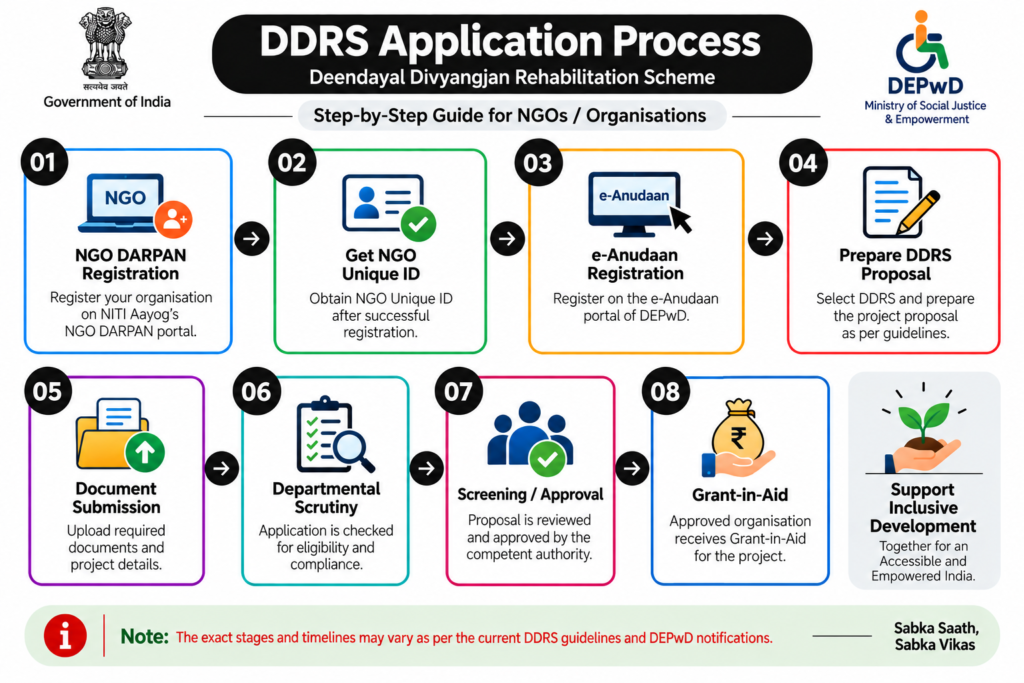
DDRS Application Process
Step 1
Register on NGO DARPAN
Step 2
Obtain NGO Unique ID
Step 3
Register on e-Anudaan
Step 4
Select DDRS & Prepare Proposal
Step 5
Upload Required Documents
Step 6
Departmental Scrutiny / Screening
Step 7
Approval & Grant-in-Aid
Step 8
Implement Approved Project & Maintain Records
The exact stages and timelines can vary according to the notification and current administrative process.
Official Useful Links
DDRS – Department of Empowerment of Persons with Disabilities
Official DDRS Page
DDRS Revised Guidelines
Official DDRS Guidelines & Documents
e-Anudaan – Grant Application Portal
Official e-Anudaan Portal
NGO DARPAN – NITI Aayog
Official NGO DARPAN Portal
DDRS FAQs
Official DDRS FAQs