Disha Scheme – Early Intervention & School Readiness
Early Intervention & School Readiness Support for Children with Disabilities |
Early Support, Development & Preparation for School
What is Disha Scheme?
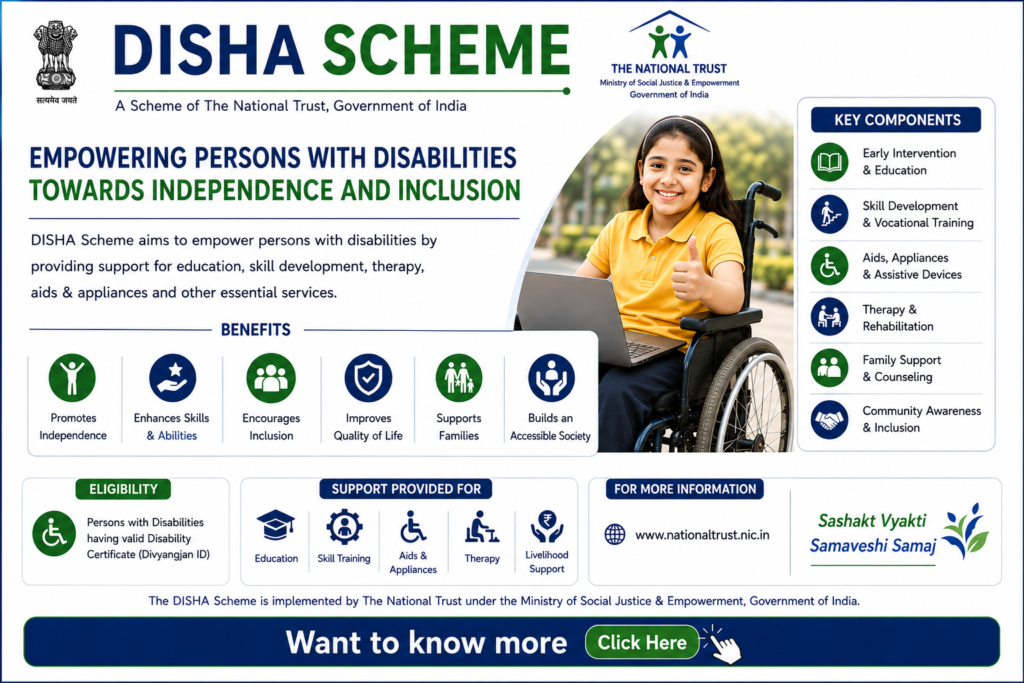
Disha (Early Intervention & School Readiness) Scheme is a scheme of the National Trust designed for young children with disabilities. The main objective of the scheme is to provide early intervention, therapy, training, day-care support and school-readiness activities during the early years of a child’s development.
Disha focuses on helping children develop important skills at an early age so that they can become more independent and better prepared for school, communication, daily activities and social participation. The scheme also provides support and guidance to parents and family members.
Who is Disha Scheme For?
Disha is primarily meant for children with disabilities in the age group of 0–10 years who have a disability covered under the National Trust framework.
The scheme covers children with:
Autism
Cerebral Palsy
Intellectual Disability
Multiple Disabilities
A child should not be simultaneously registered under the Samarth Scheme.
What Does Disha Provide?
Disha Centres provide a combination of early intervention, therapy, training and day-care services according to the child’s individual needs. he objective is not only to provide therapy, but also to help the child develop functional and school-readiness skills.
Key support may include:
🧠 Early intervention activities
🗣️ Communication & language development
🧑🏫 Special education support
🏃 Physiotherapy / Occupational Therapy
🤝 Social & behavioural development
🧩 Age-appropriate developmental activities
🏫 School-readiness preparation
👨👩👧 Parent counselling & guidance
🧑🦽 Caregiving support
🎯 Daily living and functional skill development
The exact services available can vary according to the Disha Centre and the child’s individual requirements.
Day-Care Facility
A Disha Centre is required to provide day-care facilities for at least 4 hours a day, between 8 AM and 6 PM, along with age-appropriate activities.
The centre should generally remain open for at least 21 days in a month. The standard batch size is 20 children, with provision for additional enrolment up to the prescribed limit.
This day-care support can also give parents and caregivers some time during the day to manage work, family responsibilities and other requirements.
Early Intervention & School Readiness
One of the most important purposes of Disha is to work on the child’s development before and during the school-entry stage. Children may receive support in areas such as:
Communication
Motor skills
Cognitive development
Self-help skills
Social interaction
Behavioural skills
Attention and participation
Pre-academic skills
Classroom readiness
The aim is to help the child reach their individual potential and make the transition towards regular or special education smoother.
Support for Parents & Families
Disha is not only focused on the child. Parents and family members are also an important part of the programme. Parents may receive guidance regarding:
Understanding their child’s needs
Home-based activities
Child care and development
Education options
Available disability-related schemes
Therapy and intervention
Future planning
Disha Centres may also guide families regarding other National Trust schemes and available support.
Professionals at a Disha Centre
A Disha Centre is expected to have professionals and support staff such as:
Special Educator / Early Intervention Therapist
Physiotherapist or Occupational Therapist
Counsellor
Caregiver
Aya
Availability of professionals such as a Speech Therapist and Physical Trainer is also desirable.
Who Can Enrol?
A child generally needs to fulfil these basic conditions:
Age should be 0–10 years
Child should have a disability covered under the National Trust Act
Child should not be enrolled under Samarth
Required disability and identity documents should be available
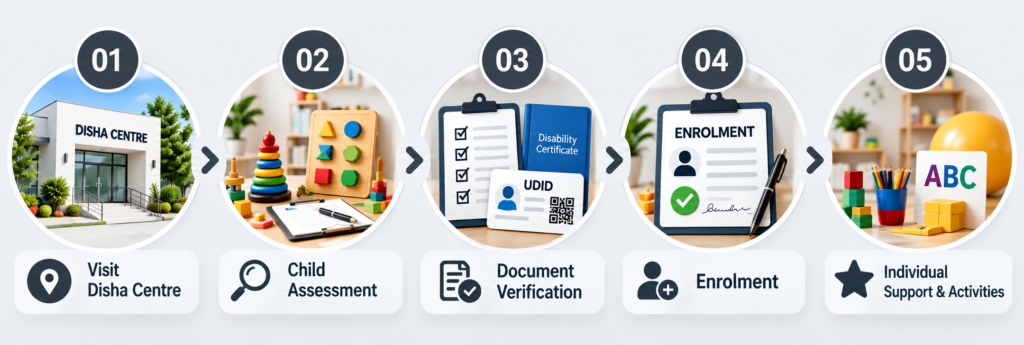
The child is assessed at the Disha Centre before enrolment so that the centre can understand the child’s needs and determine the appropriate support.
Documents Generally Required
Parents/guardians may be asked to provide:
Enrolment Form
Birth Certificate / Date of Birth Proof
Disability Certificate
UDID Card / UDID details
Income / BPL Certificate, where applicable
Parent/Guardian ID Proof
Residence / Address Proof
Other documents required by the Disha Centre
The exact documents may vary depending on the centre and applicable National Trust requirements.
How Does Disha Enrolment Work?
The assessment helps the centre understand whether the child requires Disha support and what type of intervention, therapy, education or guidance may be appropriate
Why is Disha Important for Children with Special Needs?
Early childhood is an important period for development. Early intervention can help children build communication, motor, social, self-help and learning skills at an early stage.
Disha provides a structured environment where children can receive developmental support while parents receive guidance to understand and support their child’s needs.
For families of children with special needs, Disha can therefore be an important starting point for early intervention and school readiness.
Important Note
Disha Centres are operated through Registered Organisations (ROs) of the National Trust. The services, admission process and facilities may vary between centres.
Parents should verify the latest eligibility criteria, available centres and enrolment requirements with the concerned Disha Centre or National Trust before applying.